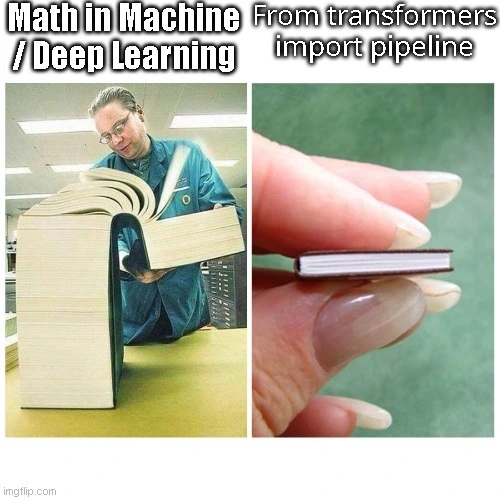
Chapter 1 (Mathematical Foundations)
What is machine learning? Machine learning is designing algorithms to automatically extract valuable information from data, with strong emphasis on automatic
Core of machine learning
There are three cores in machine learning, data, model, and learning.
Data
Machine learning is inherently data driven, to design general purpose methodologies to extract valuable information from data.
In this book, data is assumed to always be numeric so any qualitative data is processed, be it with scikit-learn's OneHotEncoder (or if I'm really lazy, a for loop with enumerate in it). So data is always seen as vectors.
What's a vectors?
- An array of numbers (Computer Science)
- An array with direction and magnitude (Physics)
- An object that obeys addition and scaling (Mathematics)
Model
To extract valuable information from the data, we need to create structures/system in place that typically related to the process that generated said data. A good model can be seen as a simpler version of real (unknown) data generation.
Learning
The most crucial part: a model is said to learn from data when its performance on a given task improves after considering the data. Learning can be understood as a way to automatically find patterns and structures in data by optimizing the model's parameters.
Where's the mathematics?
The mathematics is found in the four pillars of machine learning.

- Regression
- Dimensionality Reduction
- Density Estimation
- Classification
These common classes in Python’s machine learning libraries will be my focus on this journey. With the foundational principles of these pillars explained in detail in this book, I will distill this information and continue learning not just the material, but also how to communicate it effectively.
Acknowledgement
I can't overstate this: I'm truly grateful for this book being open-sourced for everyone. Many people will be able to learn and understand machine learning on a fundamental level. Whether changing careers, demystifying AI, or just learning in general, this book offers immense value even for fledgling composer such as myself. So, Marc Peter Deisenroth, A. Aldo Faisal, and Cheng Soon Ong, thank you for this book.
Source: Deisenroth, M. P., Faisal, A. A., & Ong, C. S. (2020). Mathematics for Machine Learning. Cambridge: Cambridge University Press. https://mml-book.com (opens in a new tab)