The White Book of the 1978 Students' Struggle
Buku Putih Perjuangan Mahasiswa 1978
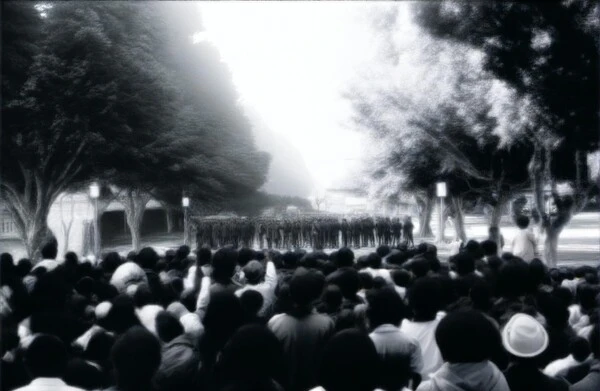
“[The students of ITB] do not trust and do not want Suharto to be President of the Republic of Indonesia again”
On 16 January 1978 the ITB Student Council published a critique of Suharto's New Order government. The military banned it within days.
6 October 1970 – 13 September 1977
What came before 1978?
On 6 October 1970 an ITB student, Rene Louis Coenraad, was shot dead on Jalan Ganesha, outside the campus, after a friendly football match between ITB students and cadets of the police academy, AKABRI Kepolisian7. The cadets who were questioned denied that any of them had fired7. The killing, known as the 6 October incident, set off demonstrations demanding a review of civil–military relations and a return to democracy5.
In October 1973 student protests in Thailand brought down Thanom Kittikachorn's military government. Jeffrey Winters writes that Indonesia's students were “further excited” by it14, and Benny Setiono that their protests grew “terinspirasi oleh aksi-aksi mahasiswa Thailand” (inspired by the Thai students' protests; translated here)15. On 15 January 1974 the Japanese prime minister Kakuei Tanaka's visit to Jakarta set off student protests that ended in riots, remembered as Malari6.
Who turned the protests into riots is still disputed. Writing in 1979, the editors of Indonesia noted that the authorities and some students blamed the student leaders, while “many others believed the riots were instigated by government agents provocateurs”13; Setiono writes that the crowd was “konon” (reportedly; translated here) engineered by Opsus, Ali Moertopo's special-operations group15.
Aimed first at Japanese cars and the Toyota Astra showroom, the riots turned on Chinese Indonesians: Setiono describes the looting of ethnic-Chinese shops in Glodok and, that night, the looting and burning of the Proyek Senen shopping centre15, and Mattias Fibiger writes that rioters “targeted Indonesians of Chinese ancestry”16. Tirto reports 11 dead, 807 vehicles burned, five newspapers banned and 775 activists arrested6; Tosa gives 700 arrested, of whom 45 were charged5.
Tosa writes that many leaders of the 1977 movement had entered university before Malari, watched the movement that led to it, and drew on its lessons5.
On 13 September 1977 students set up a “provisional parliament” to criticise the legitimacy of parliament; Tosa names among its founders three ITB students, Roeli Sanre, Ali Hilal and Ramles Manapang5. Sudomo, the commander of Kopkamtib, called it unconstitutional5.
27–28 October 1977
What was the Ikrar Mahasiswa?
The statement of position of 14 January 1978 demanded that the MPR fulfil the students' demands in the Ikrar Mahasiswa Indonesia, the Indonesian Students' Pledge, of 28 October 19773. The Cornell translation calls it the “Indonesian Students' Manifesto” and prints the date as 23 October1; the Indonesian original reads 28 October3.
The pledge came out of a meeting of student councils from across Indonesia. The University of Indonesia's student council recorded that “Bandung expressed its willingness to act as host. The meeting produced the Indonesian Students' Vow”13, and Indro Tjahjono told his court that every student representative signed the meeting's resolutions10.
Its text is dated Bandung, 27 October 1977, at 3.30 in the morning, and signed “Dewan Mahasiswa/Senat Mahasiswa”12. The text comes from Musni Umar, one of its signatories, who retyped it in 2015 from a photograph of the signed original12; in a 2012 column he quoted the second point in different words4.
On trial in 1979, Indro said the pledge “hanya berisi permintaan agar MPR meminta pertanggungjawaban presiden” (only asked that the MPR call the president to account; translated here), stopping short of withdrawing his mandate, and that the prosecution used it as evidence against him10.
Tosa records that on 27 October the University of Indonesia's student council asked for a special session to question the president directly on departures from the 1945 Constitution and Pancasila, citing Kompas of 28 October5. That is the pledge's second demand, on the day its text is dated, but Tosa does not name the pledge. On 28 October, the anniversary of the Sumpah Pemuda, the Youth Pledge of 1928, large demonstrations were held in Jakarta, Bandung and Surabaya5.
The pledge
Dengan didorong keinginan luhur untuk menciptakan kehidupan berbangsa dan bernegara yang bersih dan berwibawa dan dapat dipercaya dalam rangka mewujudkan cita-cita kemerdekaan tersebut, maka kami mahasiswa Indonesia menyatakan:
Moved by the noble wish to create a national life that is clean, authoritative and trustworthy, in order to realise those ideals of independence, we, the students of Indonesia, declare:
- 1Kehidupan kenegaraan harus dijiwai kembali oleh Undang-Undang Dasar 1945 dan Pancasila yang dilaksanakan secara murni dan konsekwen.The life of the state must once again be imbued with the spirit of the 1945 Constitution and Pancasila, carried out purely and consistently.
- 2Agar MPR segera menyelenggarakan Sidang Istimewa untuk meminta pertanggungan jawab pimpinan nasional/Presiden Republik Indonesia tentang penyelewengan-penyelewengan Undang-Undang Dasar 1945 Pancasila.For the MPR to immediately hold a Special Session to ask the national leadership/President of the Republic of Indonesia to account for abuses of the 1945 Constitution and Pancasila.
- 3Bahwa kami bertekad tetap menggalang kesatuan dan selalu dalam kebersamaan untuk memperjuangkan kebenaran dan keadilan demi kepentingan rakyat.That we are determined to keep forging unity, and to stand always together in fighting for truth and justice in the people's interest.
14–16 January 1978
What was the White Book?
On 16 January 1978 about 1,000 students rallied in Bandung and read out a statement opposing a third term for Suharto, and the White Book, the ITB Student Council's systematic critique of the government, was handed out in large numbers5. The statement of position at its head is dated 14 January1.
The statement of position opens with five considerations: that the people's lives were still far from the ideals of independence; that wrong policies and abuses of power by officials were to blame; that this showed the failure of the national leadership; that democracy needed every group to take part in choosing that leadership; and that “dinamika politik di negeri ini tidak dimungkinkan tumbuh bila jabatan presiden dijabat lebih dari dua kali berturut-turut” (political life in this country cannot grow if the presidency is held more than two terms in a row; translated here)3. Its second demand ties the book to the pledge of October: that the MPR carry out the demands of the Ikrar Mahasiswa Indonesia3. It is signed by Heri Akhmadi, the council's chairman, as the result of its deliberations of 14 January3.
Its preface says it was compiled by an editorial team of students appointed by the Student Council, drawing on newspapers, journals and government publications such as the Second Five-Year Plan1. The copy of the Indonesian original we have read carries more than the translation does3. Its cover is stamped “Dicetak terbatas” (printed in limited numbers). A council ruling of 16 January says every white book it issued had to be stamped and given an edition code, and that anyone reprinting it needed the council's written consent, could not change its contents, and could be sued if their copy differed from the council's reference copy. A letter of 17 January invites ITB alumni, scientists and readers to send their responses to the council.
The book's case is that the policies themselves are wrong: “This White Book does not merely discuss negative incidents caused by administrative errors. We want to emphasize rather that the development policies themselves are wrong”1. It traces everything to two causes, the national leadership and the development strategy1.
On politics, it calls parliament “simply a spectator to all the irregularities that are taking place within the executive”, citing the Palapa satellite bribery reports, Bulog and Pertamina, and it declares “The 1977 MPR is unconstitutional!” because 61 percent of its members were appointed, not elected1. On the economy, it charges the government with chasing GNP while 70 percent of foreign capital went to Jakarta and the people of Krawang were “reduced to eating water-hyacinths”1.
The economic case also turns against the “non-natives”. The book never names an ethnic group, but it places them in Glodok and Pintu Kecil, which the Cornell editors note are Jakarta's traditionally Chinese quarters, and says “Those who contributed nothing during the war for Independence are now enjoying most of the benefits of development” and “Most government credit falls into the hands of non-natives”. It also names the cukong, which the editors gloss as “the vastly wealthy Chinese financiers of key Indonesian political figures”1.
It turns on Suharto himself: his family's wealth, the Tapos ranch and the Mangadeg foundation, and a nepotism copied down to village heads, set against Sukarno, Hatta and Sjahrir, who never sought wealth for their sacrifices. Suharto, it says, “is becoming an ever larger stain on the Armed Forces' good name”1. The students set two goals: “to replace Suharto via the general session of the MPR in March 1978 and to change the national development strategy”, and say they have “no intention whatever of creating anarchy”1.
A second part sets out “indicators” of failure, ministry by ministry. On rice it finds that actual imports for 1978 exceeded the estimate by 400 percent, and that the Rp 240 billion subsidy on imported rice dwarfed the Rp 44 billion lent to Indonesian farmers through Bimas in 1974; it calls Widjojo Nitisastro, head of Bappenas, the “dalang” of Indonesian development1. The book closes with an appeal to the wives of officials, “especially to Ibu Tien Suharto”, holding them “to a large extent responsible for the decay of our society”1.
The statement of position
Maka dengan ini mahasiswa ITB menyatakan sikap: tidak mempercayai dan tidak menginginkan Suharto, kembali sebagai Presiden Republik Indonesia. Dan menuntut:
The students of ITB hereby declare their position: they do not trust and do not want Suharto as President of the Republic of Indonesia again. And they demand:
- 1Fraksi-fraksi dalam MPR segera menampilkan tokoh-tokoh Nasional yang berprestasi dan tidak diragukan integritasnya sebagai calon Presiden Republik Indonesia.The factions in the MPR immediately put forward national figures of proven achievement and unquestioned integrity as candidates for President of the Republic of Indonesia.
- 2Agar MPR merealisir tuntutan mahasiswa yang tercantum dalam Ikrar Mahasiswa Indonesia 28 Oktober 1977.For the MPR to put into effect the students' demands set out in the Ikrar Mahasiswa Indonesia of 28 October 1977.
- 3Agar ABRI benar-benar berdiri di atas semua golongan demi kepentingan bangsa dan negara.For the Armed Forces to truly stand above all groups, in the interest of the nation and the state.
Inside the book
- Declaration of Positionp. 151–152
- Prefacep. 152–153
- I. Introductionp. 153
- II. The Present Condition of Our Countryp. 153–164The Political Field · The Economic Field · The Sociocultural Field · The Field of Law
- III. The Reasons for the Present Condition of the Countryp. 164–165
- IV. This Is Why the Students Strugglep. 165–167
- Various Indicators of the Failure of the Suharto Governmentp. 167–180Agriculture · Finance · Transmigration, Cooperatives, Industry, and Regional Development · Trade · Public Works and Electricity · The National Development Planning Board (Bappenas)
- An Appeal to the Wives of Officialsp. 180–182
Pages of the Cornell translation [read it (opens in a new tab)]
“Contributed nothing”
Mereka yang pada waktu perang kemerdekaan tak mempunyai sumbangan apapun, sekarang mengambil manfaat pembangunan terbesar.
Those who contributed nothing during the war for Independence are now enjoying most of the benefits of development.
The original, p. 83 · the Cornell translation, p. 1621
- 1932Liem Koen Hian founds the Partai Tionghoa Indonesia, which Setiono says “jelas berjuang untuk kemerdekaan Indonesia” (clearly fighting for Indonesia's independence; translated here). In 1947 he sits in the Republic's delegation at the Renville talks19.
- Apr 1945Liem Koen Hian, Oei Tjong Hauw, Oei Tiang Tjoei and Tan Eng Hoa are named to the BPUPKI, the body preparing for independence, for the Chinese Indonesians. It is to this body that Sukarno gives his Pancasila speech on 1 June 194519.
- Aug 1945Yap Tjwan Bing sits for the Chinese Indonesians on the PPKI, the committee that takes over from it. He later sits on ITB's board of curators, and leaves for Los Angeles after the racial riot in Bandung of 10 May 1963 burns his car19.
20–23 January 1978
How was it banned?
Writing in April 1978, the editors of the journal Indonesia said the book was banned “by the military authorities within a matter of days of publication”, as part of the general crackdown on dissent of 20 January1. They did not say which body issued the ban, or under what law.
The law the Attorney General's office used to ban books was UU No. 4/PNPS/1963, on safeguarding against printed matter whose content may disturb public order2. It was an emergency law from Sukarno's Guided Democracy, issued during the Confrontation with Malaysia, and the printed matter it covered included books, brochures and pamphlets2. Neither source says whether the White Book's ban was issued under it.
The sources differ by a day on the crackdown itself. The Indonesia editors give 20 January1, and Tosa Hiroyuki, writing in 1989, says Kopkamtib, the security command, decided on 20 January to ban six major newspapers and the student papers, and that the student councils were suspended5. TAPOL, writing in April 1978, dates the army's crackdown to 21 January8.
Indro Tjahjono, tried in 1979, names the order that froze the student councils: Kopkamtib decree SKEP.02/KOPKAM/I/1978, signed by its chief of staff, Admiral Sudomo10.
His plea quotes the council's own chronicle: “21 Januari 1978 penangkapan-penangkapan mahasiswa secara besar-besaran di mulai. DM/SM se Indonesia dibekukan kegiatannya, Pers diberangus” (on 21 January 1978 the mass arrests of students began; the student councils across Indonesia were frozen, the press muzzled; translated here)10.
Rum Aly writes that the education minister, Sjarif Thajeb, dissolved the ITB Student Council, led by Heri Akhmadi, on Kopkamtib's orders11.
On 23 January Sudomo explained the crackdown in the commander's name. The plea quotes him accusing individuals in the student councils of abusing freedom and democracy, “menjurus tindakan melawan konstitusi dan melanggar hukum” (tending towards acts against the constitution and the law; translated here)10. The plea lists the papers stopped, citing the same explanation: Kompas, Sinar Harapan, Merdeka, Pelita, The Indonesia Times, Sinar Pagi and Pos Sore10. TAPOL's February bulletin also counts seven, and 158 arrests by 27 January9; Tosa counts six5. Rum Aly dates the papers' closure to 25 January, two days after that explanation11.
None of these sources gives a date for the White Book's own ban, or names the body that issued it1,5,8. Rum Aly says only that the authorities “segera melarang secara resmi” (soon officially banned; translated here) the book11.
The English translation in Indonesia was made by the journal's editors17, Benedict Anderson and Judith Ecklund18. The ban was one of their reasons for printing it: the book had become “a rare bibliographical item to which readers may not otherwise have ready access”1. A year later the journal did the same with the defence pleas from the students' trials13.
21 January – 5 December 1978
What happened to the students?
On 21 January troops entered the ITB campus, saying they would arrest the Student Council's chairman and seal the campus radio transmitter, 8EH. The students inside refused both, because the troops had not first asked the ITB leadership's permission10. Rum Aly writes that the West Java security command sealed Radio 8EH that day, and that student leaders, most of them from ITB, were arrested at the same time11.
On 28 January 1978 students called a strike to demand the release of the students arrested at ITB5,11, and public figures including Adnan Buyung Nasution, W.S. Rendra and Mochtar Lubis called for the press bans and the arrests to be reconsidered5.
The council's chronicle records two occupations of the campus10. At 4 a.m. on 1 February a combined force of Kostrad airborne troops, military police and the Bandung garrison occupied ITB, carrying a list of 53 people to arrest, five of them lecturers; after checking student cards they detained 17 students10. At 2 p.m. on 9 February troops from Kujang I Kostrad, Kopasandha, the military police and the infantry surrounded the campus, herded the students to the basketball court and the staff to the football field, beat and trampled the students at the front, and carried off the Student Center's papers, typewriters and photocopier10.
Tosa writes that the 9 February raid left casualties, a word that covers the killed and the wounded alike5. A letter from the PPP group in parliament, quoted in the plea, describes students beaten and stabbed with bayonets, “luka parah” (badly wounded; translated here), and taken by truck to the regional security command; it adds that the rector Iskandar Alisyahbana's house was fired on by unidentified gunmen10. Neither source says whether anyone died5,10. Rum Aly writes that the occupation of ITB and the other Bandung campuses lasted until 25 March 197811.
Tosa writes that the main legal basis for arresting students was the lèse-majesté articles of the criminal code, articles 134, 137, 207 and 2085. He adds that these clauses had been in use since Dutch colonial rule, with some amendments5.
On 3 April 1978 Sudomo and Benny Murdani pressed the education minister, Daoed Joesoef, to “normalise” the universities. On 5 December he formally instructed the rectors to do so, in the policy known as NKK, Normalisasi Kehidupan Kampus5.
Sources
- 1Student Council, Bandung Institute of Technology, “White Book of the 1978 Students' Struggle”, trans. with an editors' note and footnotes, Indonesia 25 (Cornell Southeast Asia Program, April 1978), pp. 151–182 Read it (opens in a new tab)
- 2Iwan Awaluddin Yusuf et al., Pelarangan Buku di Indonesia: Sebuah Paradoks Demokrasi dan Kebebasan Berekspresi (Yogyakarta: PR2Media, 2010), pp. 62–63, 77–79. A media-freedom group's case against book bans Read it (opens in a new tab)
- 3Dewan Mahasiswa ITB, Buku Putih Perjuangan Mahasiswa 1978 (Bandung, 16 Januari 1978). The Indonesian original, in a scanned copy kept here, 40 pages Read it (opens in a new tab)
- 4Musni Umar, “Pemerintah Bersih, Tema Perjuangan Mahasiswa 34 Tahun Lalu”, detik.com, 24 January 2012. An opinion column by a participant in the 1977–78 student movement Read it (opens in a new tab)
- 5Tosa Hiroyuki, 「インドネシア権威主義体制と学生運動」 [The Student Movement under the Authoritarian Regime in Indonesia, with Particular Reference to the Period 1977–1978], Tōnan Ajia Kenkyū 27:1 (Kyoto, June 1989), pp. 81, 83, 88–90, 92–93, 95–96. A Japanese political scientist, drawing on newspapers of the time and 1988 interviews with the movement's leaders; quotations translated here Read it (opens in a new tab)
- 6Husein Abdulsalam, “Malari 1974: Protes Mahasiswa yang Ditunggangi Para Jenderal”, Tirto, 14 January 2018. An Indonesian news site's account, drawing on the memoirs of Soemitro, Jusuf Wanandi, Ali Sadikin and Yoga Sugama Read it (opens in a new tab)
- 7Rum Aly, “ITB, Peristiwa Berdarah 6 Oktober 1970 (1)”, socio-politica.com, 6 October 2013. The author's excerpt from his Menyilang Jalan Kekuasaan Militer Otoriter (Jakarta: Penerbit Buku Kompas, 2004) Read it (opens in a new tab)
- 8“Repression of student dissent”, TAPOL Bulletin no. 27 (London, April 1978), pp. 1–2. A London campaign group for Indonesia's political prisoners, reporting at the time Read it (opens in a new tab)
- 9“Crackdown on dissent”, TAPOL Bulletin no. 26 (London, February 1978), p. 1 Read it (opens in a new tab)
- 10Sukmadji Indro Tjahjono, “Indonesia di Bawah Sepatu Lars”, defence plea before the Bandung court (1979), copied by the ITB Student Council's defence committee in September 1979 and transcribed on the author's blog, 18 March 2014. The plea of a defendant, caretaker of the 1977 ITB Student Council presidium; it quotes Kopkamtib's decree and the council's own chronicle, Perjalanan di Awal Tahun 1978; quotations translated here Read it (opens in a new tab)
- 11Rum Aly, “Pendudukan Kampus 1978: Luka Ketiga Dalam Hubungan Mahasiswa-Tentara (3)”, socio-politica.com, 6 April 2010. Reworked, the site says, from his Menyilang Jalan Kekuasaan Militer Otoriter (2004), a book on the Bandung student movement of 1970–1975 Read it (opens in a new tab)
- 12Musni Umar, “Ikrar Mahasiswa Indonesia”, Kompasiana, 25 November 2015. A signatory's retyping of the signed original, from his photograph of it at the pledge's 38th-anniversary exhibition in Bandung; quotations translated here Read it (opens in a new tab)
- 13“Defense of the Student Movement: Documents from the Recent Trials”, Indonesia 27 (Cornell Southeast Asia Program, April 1979), p. 19. Translated trial documents, among them the University of Indonesia student council's record of its activities, with the editors' notes Read it (opens in a new tab)
- 14Jeffrey A. Winters, Power in Motion: Capital Mobility and the Indonesian State (Ithaca: Cornell University Press, 1996), p. 108 and n. 31. A political scientist, whose account of the students draws on interviews with their leaders Read it (opens in a new tab)
- 15Benny G. Setiono, Tionghoa dalam Pusaran Politik (Jakarta: TransMedia Pustaka, 2008), pp. 1026–1027. A history of Chinese Indonesians in the country's politics; quotations translated here Read it (opens in a new tab)
- 16Mattias Fibiger, “The International and Transnational Construction of Authoritarian Rule in Island Southeast Asia, 1969–1977” (PhD dissertation, Cornell University, 2018), p. 262 Read it (opens in a new tab)
- 17“Table of Contents”, Indonesia 25 (April 1978), which lists the White Book as “Translated by the Editors” Read it (opens in a new tab)
- 18“Note from the Editors”, Indonesia 25 (April 1978), which names the issue's editors Read it (opens in a new tab)
- 19Benny G. Setiono, Tionghoa dalam Pusaran Politik (Jakarta: TransMedia Pustaka, 2008), pp. 456 and 543–545, on Chinese Indonesians in the independence movement; quotations translated here Read it (opens in a new tab)